
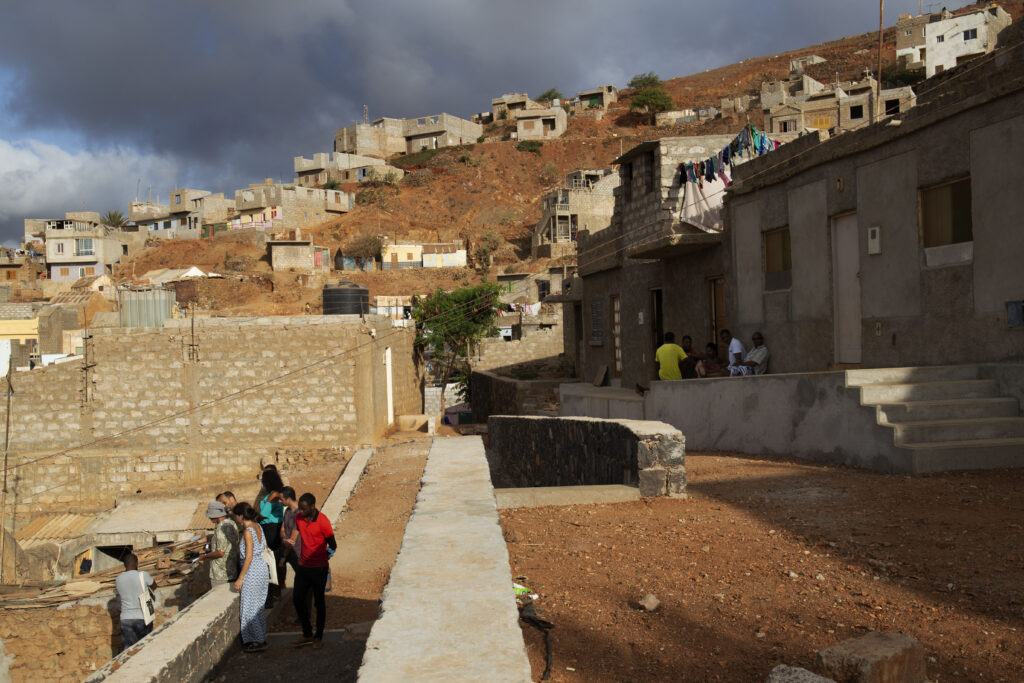
The Somá na Ponta gathering highlighted the need to further refine the conceptual foundations of the Iniciativa Outros Bairros (IOB). This included strengthening local action through adjustments to the organization of construction works to optimize them as much as possible according to the scale of local contractors.
Additionally, it reinforced the possibility of carrying out any type of action to understand the pathways to the metaphors that sustain life in the neighborhoods. It involved understanding the public positioning of different groups, the Mindelo community, the Ministry of Infrastructure, and, above all, local residents.
As a generator of employment and a core element of physical transformation, the construction works confronted the challenge of insufficient demand to employ all unemployed individuals; the need to expand social and institutional relations among different groups; and the task of building dignity into the space, which undoubtedly lies at the center of creating what is shared and common.Although architecture and urbanism are not central from an authorship perspective in the IOB conceptual framework, but rather in terms of their inscription in the political, it should be noted that consolidating an existing urban fabric and affirming it within the broader process of planetary urbanization indeed positions architecture and urbanism as central within the collective process. While the construction work was a concrete action with a defined time and place, it was the impermanence of public space activation activities that stood out most during the Somá na Ponta gathering.